
By Annemie Willer, manager WearCheck ARC Division
A Computerised Maintenance Management System (CMMS) is an important tool for managing maintenance activities. But there is a risk when the system begins to drive maintenance decisions rather than support them.
In my experience, this happens when completing tasks, closing work orders and meeting system-generated schedules become more important than responding to what is actually happening on the plant.
A CMMS can only generate and track what people structure and capture within it. It does not know whether a task is still relevant, whether the machine has changed, whether the allocated time remains realistic or whether the work being scheduled will actually prevent failure.
Most maintenance systems are built around fixed asset structures, planned durations and predefined workflows. The plant itself is not fixed. Machine condition changes according to load, production demands, maintenance quality and developing defects.
A static system managing a dynamic plant
Condition monitoring is often associated with reducing downtime, extending equipment life and improving reliability. But condition monitoring itself cannot achieve these outcomes.
Maintenance action does.
Condition monitoring should tell us what is wrong, where the problem is occurring, why it is happening and, importantly, when maintenance needs to intervene.
It should therefore not simply become another task on an already crowded maintenance schedule. It should influence and improve that schedule.
Every condition monitoring programme should begin with a clearly defined scope covering the machines, technologies, monitoring frequencies and workload involved. The team can then manage that scope and measure compliance against it.
Routine condition monitoring activities do not necessarily need to be divided into thousands of individual CMMS tasks simply so that every hour can be accounted for. Where a machine already has an inspection or preventive-maintenance job card, the condition monitoring requirement can often be incorporated into that activity. The CMMS should primarily receive corrective work generated from condition monitoring findings.
The schedule needs to reflect reality
Modern condition monitoring equipment allows data to be collected quickly, but that advantage is lost if technicians cannot reach the machines because the maintenance schedule is already full.
The system may, for example, allocate four hours for an alignment. In practice, waiting for production, permits, isolation and maintenance support may extend that work to seven hours.
The original estimate remains in the system even though the real working environment has changed.
The same principle applies when condition monitoring identifies a developing failure. The maintenance schedule should change.
Preventive work may need to be brought forward, replaced, combined with corrective work or removed entirely. Instead, organisations often leave every existing task in place and simply add the new recommendation on top.
Over time, one machine can accumulate numerous inspections, checks and recurring job cards without anyone reviewing whether every task, frequency and technology is still technically justified.
Maintenance schedules also need maintenance
One of the issues I regularly see is that organisations maintain their machines, but do not maintain the maintenance strategy itself.
Tasks continue because they have always been there. Frequencies remain unchanged. Planned durations are not reviewed. The system gradually becomes less representative of the physical plant.
We see the consequences of this in condition monitoring data.
A developing failure mechanism is identified and corrective action is recommended. The following month, the data shows that the condition has progressed. The recommendation remains open, is postponed or is closed with an administrative explanation.
The condition continues to deteriorate until the available warning period is gone and the defect reaches an advanced stage.
In this situation, condition monitoring has not failed. The warning was available. The failure occurred because the information did not result in timely maintenance action.
Closing work orders is not the same as improving reliability
Maintenance KPIs can unintentionally reinforce this problem.
A common question in maintenance meetings is whether all the week's work orders have been closed in SAP or another maintenance system.
That measures administrative completion. It does not necessarily measure reliability.
I believe the more useful questions are:
- Did we intervene in time?
- Was the recommended action correct?
- Did the machine condition improve?
- Did the defect return?
- Was the original diagnosis accurate?
These questions tell us far more about whether the maintenance strategy is working.
If the recommendation was wrong, follow-up condition monitoring data should expose it. If the recommendation was correct but the work was completed too late, then the organisation failed to respond in time. If the work order was closed but the machine condition did not improve, the maintenance intervention itself needs to be investigated.
That is a more meaningful form of accountability.
Somebody must own the condition of the machine
An over-reliance on the CMMS can result in a situation where a work order is closed while the machine remains defective.
Administratively, everything may appear complete. Technically, the problem still exists.
The foreman may say the task was not on the system. The planner may say no notification was raised. The engineer may say the work was not approved. The condition monitoring team may confirm that the recommendation was issued.
Everyone may have followed the process, but nobody took ownership of the machine.
This is also why terms such as condition-based maintenance and predictive maintenance need to be considered carefully.
Condition monitoring is not predictive maintenance if nobody acts on the prediction.
An organisation that wants to operate a genuine condition-based maintenance programme must create capacity for the work that condition monitoring generates. It cannot retain every existing preventive task, introduce additional monitoring technologies and expect the same maintenance team to absorb all the additional work.
Reliability requires technical ownership
Dedicated personnel need to focus on reliability-centred maintenance work and must have sufficient time and authority to act on developing problems.
Whether that person is called the Reliability Engineer, Reliability Manager or something else is less important than the competence and authority attached to the role.
They need a strong maintenance background, an understanding of condition monitoring and regular communication with the condition monitoring team.
Authority is important. Without it, the reliability function simply becomes another part of the same administrative process.
Follow-up testing is equally important.
A closed work order does not prove that the defect has been removed. After maintenance has been completed, the machine should be retested. If its condition has not improved, the team needs to determine why.
The reliability process should be:
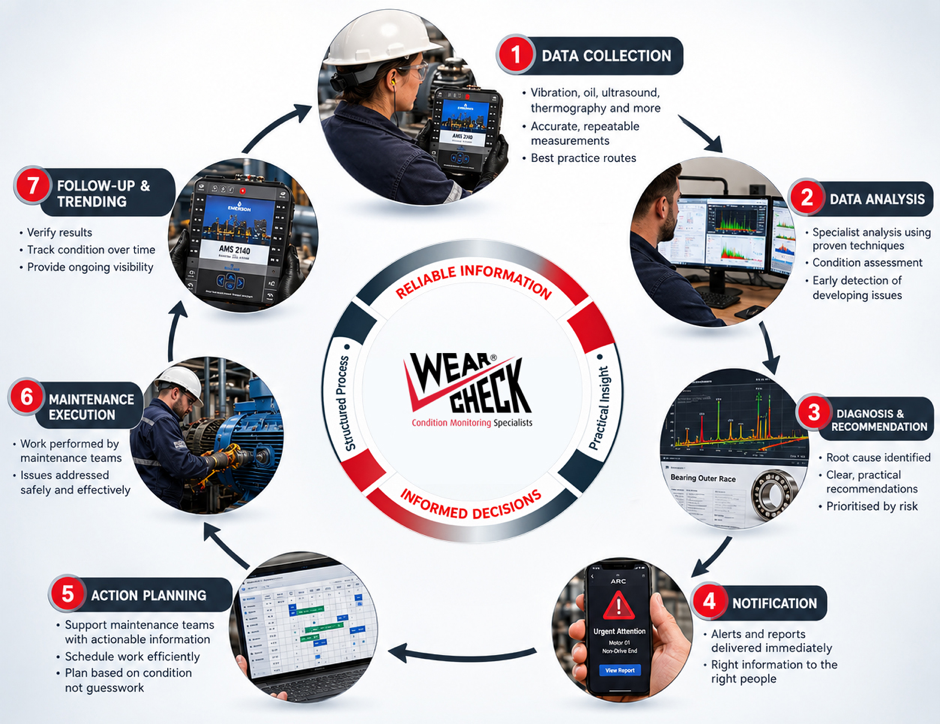
Detect. Diagnose. Act. Retest. Confirm.
The system should support technical judgement
The problem is not the CMMS itself. SAP, IBM and other maintenance systems provide the functionality organisations need to manage maintenance activities.
The problem occurs when the system begins replacing technical judgement.
Maintenance strategies need to be reviewed. Schedules need to change as machine condition changes. Recommendations need clear ownership. Experienced people need the authority to question the system when what they see on the plant does not match what appears on the screen.
We should not manage the plant around the maintenance schedule.
We should manage the maintenance schedule around the plant.
The schedule must serve the plant, not the other way around.
After 50 years in condition monitoring, WearCheck knows one thing for certain: systems may keep the records, but people keep the machines running. Speak to our experts if you need to know more!